A personal statement

In recent years, as a rising number of voices far more qualified than my own began speaking out on racism from the standpoint of their personal experience, in movements like Black Lives Matter, I thought it more appropriate to speak less and listen more.

While it was mainly an act of deference, it also partly came from a fear that my own voice might further add to what I viewed as a dangerously monotonous chorus perpetuated by social media, a superficial facade of allegiance rooted less in justice and more in fashion, something I saw as alarmingly characteristic among people–particularly in the white community–in this rising technological and social media age.

While this point of view had some merit, it’s one I can no longer fully practice. I’ve had the opportunity to educate myself more deeply over the last few years, and while that experience certainly continues, my silence has reached it’s end.

I am a musician. I play American music. I often play what some people call Roots music. The term is typically used to group together folk music, jazz and the blues—art forms unique to America that shaped the music we enjoy today, an enduring tradition through which we continually express ourselves.

As such, it’s a useful conduit to understanding the broader history and dynamic character of this country. While all communities have shaped and continue to shape that character, it is critical to understand that Black people specifically laid down this country’s foundations—both literally and to a large extent, culturally. For me, a great part of understanding that foundation has been through the music they’ve given to America, and to the world.

This wasn’t an act of mere patronage on my part. It wasn’t done out of pity or wanting to better understand a community that I viewed as separate from my own, much less from me. It was an act of studying my country and by extension, myself. It’s been an intensely personal, at times painful, and ultimately gratifying experience.

Still, as I continue along this road, which often feels cyclical as well as linear, I’ve returned to one specific realization over the past few weeks. It’s simply impossible for me to continue playing American music without actively speaking out against racism. To do so would be a betrayal of my personal and artistic roots and to the generations of people who profoundly shaped our country and way of life, one that I celebrate every time I sing, or strum the guitar.

I recognize that they aren’t my ancestors, but without question, they are my musical forbearers; and I cannot, I will not turn my back on them. To do so would be to turn away from myself.

So while this is just a brief summary of my own personal experience as an artist and American citizen, my ultimate intention is that is serves as a call to action for anyone still ambivalent about their stake in this country, in something bigger than themselves.

We must fully recognize racial justice as a cause relevant to more than just one community, and recognize the necessity of it being no longer their fight, but our fight. What happens to one of us will and should affect the other. The riots in our cities are living proof of that universal reality, and while I don’t advocate violence, I implore everyone to communicate, openly and with respect, preferably face to face.

To abstain is to compromise not only the welfare and prosperity of one people, but the soul and lasting integrity of our country.

Until these virtues are fully realized, so long as people of color continue to suffer under the tyranny of systemic racism, persecution and oppression, we should–at the very least–expect people to kneel when we sing the national anthem.

____

Resources to Take Action
https://blacklivesmatters.carrd.co/

canyons at dawn

by Ren Michael

stepping out
from the canyons at dawn
the pain of the world’s
left him humbled and strong
before a breeze
most familiar
and yet brand-new,
he breathes in the view
receiving rhythm and tune

rising from the river
like the birth of the blues
between the symphonic currents
of the beautiful Danube

go with it, friend
and embrace the flow
as you remember again
the things you’ve always known

and never be afraid
for we are one
heart and soul
we’re the bull in the rain,

with a new world to grow


I Can’t Breathe

By Ren Michael

I’ve been told to believe in equality
but if that’s reality, it’s never been seen
when you see a color before you see me
and feel like a target every step up the street

you ought to stay home, don’t give ‘em the bait
keep away from the windows, they’re no longer safe
if you’re gonna be out, don’t make it too late
how calm would you stay? how long would you wait?

I don’t care if you’re hip
I don’t care if you’re woke
I’m not looking to be anyone’s token
Have you felt such rage
You could choke on the pain?
Have I got a friend
who won’t fade away
like smoke in the rain?

how many songs, mantras, manifestos will be written?
you don’t have to leave it to the blowin’ of the wind
we might depend on the poets to express what we know
or say it ourselves in the world that we grow

So you gaze outside at that rain breaking ground, and
you say you won’t abide the same recycled  sounds
that you won’t abide fear in your own hometown
so you’re done with a discourse of making the rounds
are you ready to lay your destiny down?

you say you’ll never know what another man feels
though you may have wounds that never did heal
and you’ll never understand the reason we kneel
until you recognize the wounds as real

I want a country, a home, a creed in which I can believe
A flag and anthem that rings true to me
But I’ve gone too long, unheard and unseen
I’m tired of waiting, and I can’t breathe

Breakfast in Vicksburg

I reached Vicksburg late in the morning, after four days on the road.  It’s known as a historical site of the Civil War, but I knew it as Willie Dixon’s hometown.

The cafe stood on the north end of Washington Street. I sat down and ordered a cup of coffee, a toasted bagel with cream cheese and a slice of tomato.  That’s my favorite breakfast, and that morning I found myself looking for anything familiar, anything that felt close to home. I even missed the morning paper, but then I figured I was probably better without it, at least for today.

During that point in March, we weren’t in full quarantine mode and businesses like this one were still allowing people to come in. About five or six were sitting inside when I arrived, a few gathered around a coffee table in cozy armchairs chatting like any ordinary day, which was fine by me. It was nice to see a little civilization again, especially when I considered that it might be one of the last times for a while.

I don’t think any of us had come to accept how dire things would get in just a few more days. At this point, the consensus was just wash your hands and eat well. Keep the immune system up. Social distancing hadn’t become a thing yet.

Still the feeling of not knowing exactly when I’d be back hit me a little harder than usual, and not just because of everything happening in the rest of the world.

This wasn’t my first visit to Mississippi, nor the second or third. I’d always driven through from California to Florida or vice-versa over the years. One time, only a few years prior, I’d stopped along Highway 61 en route to New Orleans from Nashville and slept just a few steps away from the bank of the river. That was in Rosedale, maybe a hundred miles to the north of Vicksburg.

I wrote a little in my notebook, then finished breakfast and walked upstairs toward what they called the Attic. I heard the faint sound of a piano playing, growing louder as I reached the second floor.

I stood in a vast gallery of vibrant colors, rare antiques and a few old recycled instruments; local art seemingly paying tribute to the town and it’s rich musical heritage.

The man who ran the place sat in his chair and welcomed me in, reminding me to let him know if I had any questions. He sat beside a record player. The vinyl jacket placed beside it. The sounds of the piano came in only a little scratchy, but still clear. Arthur Rubinstein playing Beethoven sonatas.

Much like central Europe, where so many well-known composers lived and worked, Mississippi was the home-state for an equal number of extraordinary American musicians in the early twentieth century. And so like with central Europe, its tempting to wonder at first whether there was something in the water at that time in history.

Here they were now, looking out at me through canvas portraits or old black and white photographs. Robert Johnson, Charley Patton, B.B. King, Albert King, Willie Dixon, Son House, Muddy Waters, Howlin’ Wolf, Bukka White, Skip James, and John Lee Hooker. All born in Mississippi.

I hadn’t visited many places in the state like this, places that so visibly recognized it’s history. Maybe that’s because there weren’t too many to begin with, at least no big avenues or bustling boulevards remotely close to the iconic and tourist-jammed sites like Broadway in Nashville, Beale Street in Memphis or Bourbon Street in New Orleans.

In Mississippi, there were grave sites. A few hidden plaques. A famed highway. Crossroads. And then, there was the river.

I left the gallery and made my way back outside. I turned off Washington and down Grove Street, along the slope that dips sharply down toward the river. Docked on it’s bank stood an old steamboat gleaming in white beneath the afternoon sun. It was empty and left unattended. It looked almost abandoned like a ghost ship that wasn’t supposed to be there, hiding in plain sight. There it lie, some quiet reminder of days long past.

Except they didn’t feel past at all. For me, the past was never really past. I looked out over the river which always has a funny way of reminding me of these things, typically when I need the reminder most. Maybe that’s why I always come back to it. Maybe there is something in the water.

Here the connection between the land and the music is far easier to trace than it might be in the case of Central Europe. For one thing, the origins of the blues lead back to life on the plantation before the Civil War, to the slaves who worked from sunup to sundown, who sang as a way of not simply passing time, but as a critical means of holding onto the humanity they might have otherwise lost.

They had no formal musical instruction, no understanding of theory at all. Still the music sounded as beautiful as anything ever composed under hours of intense professional or academic scrutiny, something that underscores the nature of creativity and how much is informed by human experience over theory, how it may come as much from sheer necessity as intention, if not more so.

The style, as well as the songs themselves were passed on from the slaves to their descendants, through Reconstruction and Jim Crow south, and with every generation the songs, though thematically growing more varied and complex, remained as true to the basic form as it does today.

Though its themes never avoid the harsh realities of life, such as the pain of body or spirit, poverty, jealousy or death itself, the blues frequently acknowledges love, redemption, friendship, travel and hope. Even in the case of those songs of loss–and there are many of them–the very act of singing the songs was and remains an act of survival, a means of recognizing what must be recognized before it can be overcome.

When the train left the station, it had two lights on behind
The blue light was my baby, and the red light was my mind
-Robert Johnson, “Love In Vain”

Any form of expression that acknowledges life with such a wide and sober lens is bound to stand the test of time, and rightfully so, because it’s language is universal and deeply relatable, it’s music as raw and recognizable as the forces of nature and the land itself.

For me, no other music achieves this as completely as the blues. It is more honest and unique to the history of America than anything else I know, so timeless that it feels elemental. When I hear it, I hear those who’ve come before and those who will follow. I hear the river. I can feel it flowing as gently as it has done for millennia, and will continue to do for generations to come.

It’s significance is made all the more poignant by the fact of its origin, that it was created by the same men and women who built so much of the country as we know it today, who literally laid down it’s foundations.

It’s part of a long tradition intimately tied to the history and character of this land. It is American Music. I remember that every time I play it, and every time I sing.

Somehow, through the strange and uncertain times that lie ahead, it would would help anchor me in a way few things ever could. And though some time has passed since that quiet afternoon by the river, I’m still there.

I never really left.

Issue #4
Q&Co.

P.S. Here’s a playlist
we made for your listening pleasure
Our selection of personal favorites in the blues
We hope you enjoy.

Triumph of the Imagination

Now that we’ve been in this lockdown for nearly two months I find myself wanting to get back to another world, one that I manifest through sheer will and can fully inhabit, maybe even share with others. I’m kidding, sort of. I’m just a humble writer with a humble new magazine. But I can understand the impulse.

It was the guiding impulse of Walt Disney’s life and career, according to biographer Neal Gabler, author of Walt Disney: The Triumph of the American Imagination.

Inscribed in it’s opening pages is an excerpt from William Blake–one of our favorite poets–whose words hint as to where the rest of the book is going.

I must create a system
or be enslaved by another man’s;
I will not reason and compare:
my business is to create.

William Blake
“The Marriage of Heaven and Hell”

I don’t mean to spoil the ending, but Disney succeeded. I’m sure you knew it by looking at everything today that bears his name. Disney, the man who launched a groundbreaking animation studio that revolutionized motion pictures. Disney, who created a theme park that continues to dramatically influence American culture, for better or worse.

A sympathetic view might say that his creative legacy and the force of his imagination inspired the imagination and creativity in countless generations to come all around the world, while critics might insist that the legacy of his films, the parks and merchandise only glorify some childlike escapism, a tacky sentimentality and gross materialism.

I can’t lend much to the discussion either way, one that most people might have anticipated before even reading the book. How a person connects to the films and theme parks is their own business.  I only finished the book with a renewed perspective on a man far more complicated than I realized.

What I never expected to learn was how many times he failed. How ridden with obstacles, and miseries and all sorts of horrible anxieties that long road became, the road to his own utopia, the road that ultimately never ended.

Throughout the book I found myself revisiting one question in particular. One that I think is essential in understanding the nature of success itself, specifically in this country. To what degree did his achievements rest on the ingenuity of other people?

It’s the gray area of his life and career that proved the most compelling for me. The relationship between the big idea and the details. The back-and-forth from which, it turns out, most of his problems arose.

I wondered if he ever missed the old days when he started in mixed animation and live-action shorts, and only needed a small crew and a couple of friends to stand in front of the camera.

His talent was more in coming up with ideas, and less about the smaller details on how to realize them. Of course those details played the most decisive role in getting the task done, and so naturally a far greater deal of credit is owed to those with whom he surrounded himself.

Still, the more heads in the room, the more problems arose; and it wasn’t long before he suffered one of the most devastating disappointments in his career following the studio’s loss of it’s first original character, Oswald the Lucky Rabbit, the rights for which were lost during a contract dispute with Universal Studios.

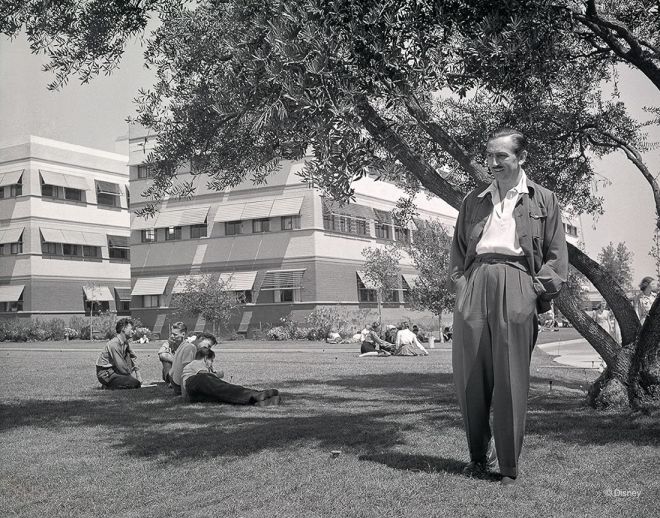
Walt standing in front of the Animation Building, the creative hub of the studio.

It’s worth noting that, shortly thereafter, Disney and chief animator Ub Iwerks created a new character that launched Disney and his studio to international fame and served as the creative foundation from which everything would follow.

Yet from that point on, he had a harder time trusting people, which only grew following the labor strike in the early 1940s, shortly after the success of Snow White and the subsequent financial losses incurred from Pinocchio and Fantasia, cemented as classics today despite nearly bankrupting the studio at the time.

It survived but was never the same. For a brief moment before the strike, the studio had served as the closest thing to Walt’s very own creative utopia, a community of visionaries operating at the intersection of art and technology, constructing worlds that broadened the public imagination and provided a psychological, emotional, even transcendent experience for anyone willing, if not just for the artist themselves.

Following years of creative stagnancy, Disneyland was the first project to resurrect that old vision. As he once did with the animation studio, he could regard it as a perpetual work in progress, something that was both a creation in itself and a workshop for continued ideas.

Creation was the guiding impulse of his life; and so by that measure, on a core level at least, Disney was an artist, first and foremost. While the scope of his creative vision is arguably unparalleled, his greatest successes seem equally linked to his ability to manage and lead other creative people in seeing that vision realized.

Walt introducing EPCOT for a promotional film

Shortly after the park’s completion and enormous success, he started planning a second and far more ambitious project that would serve as the apotheosis of his creative energies.

Where Disneyland had become the quintessential amusement park, this would serve as the quintessential city. The Experimental Prototype City of Tomorrow. Unlike the theme park and most of the innovations bearing his name, EPCOT would form a fuller synthesis between his own imagination and the real world, an environmentally sustainable community, free of pollution where people would actually be able to live and work harmoniously.

It would break down the long-standing walls between the fantasy worlds he helped create and reality, and challenge the long-standing critique that he was more preoccupied with escaping our world, rather than changing it.

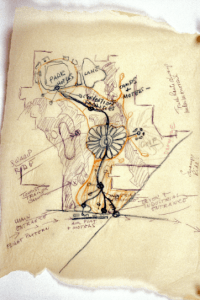
Walt’s own sketch of the EPCOT project

An artist can stay true to their vision and hope others relate to it, but of course they have little control over that in the end. Disney learned as much through frequent creative disappointments that likely sobered his own perspective on the matter.

He passed away before EPCOT was ever approved, and today what stands in its place is a much smaller version of what he envisioned, a theme park only hinting at the community he had in mind.

One might dream ’till the cows come home, but when it comes to the big ones, it takes communicating to others, appreciating and counting on them to help make it happen. Recognizing the stake one person has in the other.

We could guess how well Disney understood that in the end. My guess is that he knew it, and that through every failure and subsequent success, he was always working on it.

I also think it’s no small thing how EPCOT as he saw it, represents that idea more directly than anything else he ever put to paper.

I hope someday we’ll see it realized.

Issue #4
Q&Co.

Facing Fear, One Page at a Time

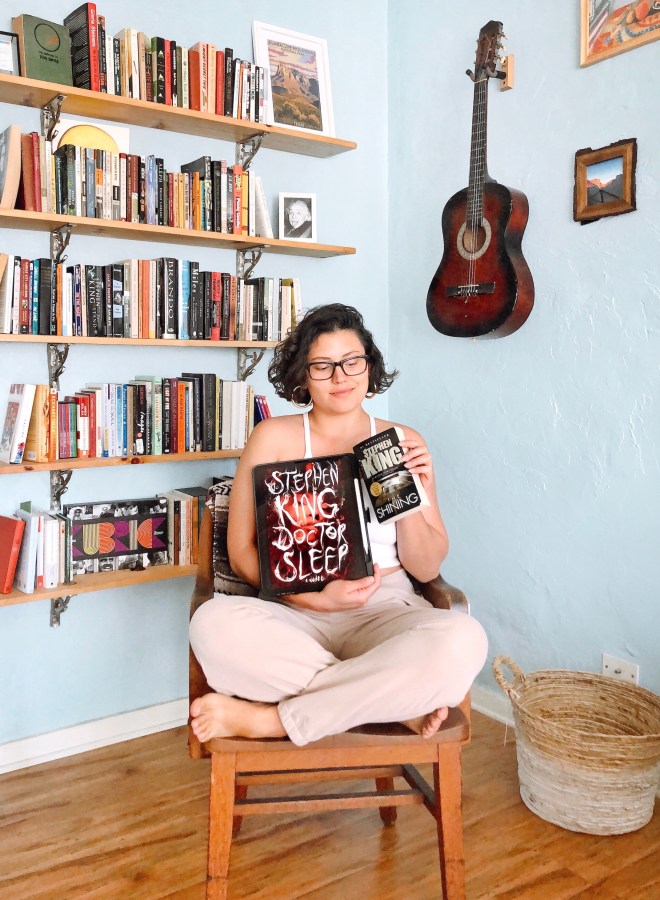
One of the first things to come up in a Google search of Stephen King is that he “is an American author of horror, supernatural fiction, suspense, and fantasy novels.” Now, I’m late to the Stephen King fandom but I always associated the name with just horror, not supernatural fiction, suspense and fantasy.  Therefore I assumed he was just not for me, since I am not a horror fan, whether it’s books, movies, shows, etc. 

What is it about the horror genre that I dislike so much? It’s not so much the fear it invokes while watching the movie or reading the book. It’s the fear that pops up.  For example, during those middle of the night bathroom visits, when it’s pitch black and extremely quiet in my home. All of a sudden, my senses are heightened and my mind begins to think about all the scary things I’ve seen or read about before, making it that much harder to get back to sleep. 

You know that famous shower scene from Alfred Hitchcock’s Psycho? I never even saw the movie before last year, and that scene haunted me for most of my life. Spoiler alert: it’s not even a scary movie. 

My boyfriend, on the other hand, is not only a fan of horror but a huge Stephen King fan, and for the last four years he’s been trying to get me to watch some of his favorite movies and read some of his favorite books…and I finally caved.

I started with the Dark Tower series last year and I zoomed through the first two books. Then I was told how much I’d enjoy The Shining.  I’d never seen the famous Stanley Kubrick movie, but after months of convincing I finally trusted that I might enjoy the book.  

If you’ve ever read The Shining then I’m sure you remember what an incredible story it is, and not so scary after all, at least not until the last third of the book.

The richness and complexity of these characters, and the development of the plot make you feel like you’re a part of this family, slowly being manipulated by the Overlook Hotel. One of my favorite parts of the book is that you empathize so much with each person; which, by the way, was something I felt strongly lacking in Kubrick’s adaptation, which I saw shortly thereafter, but that’s a discussion for another time.  The point is that I was enthralled by the story at every page.  I couldn’t put the book down and it led me straight to the sequel, Doctor Sleep.

Now, I don’t want to give away any spoilers for anyone who hasn’t read either of the books, but let me just say this is one of my favorite stories I have ever read.  I finished Doctor Sleep in about three days and was left in complete and total bliss. I cried at the end, felt so much joy and perfect closure for a story that I got to experience full circle. I felt like another member of the family I’d just spent so much time with and we just said a long and heartfelt farewell to each other. I highly recommend reading The Shining and then Doctor Sleep, back-to-back to get the full effect. 

I finished Doctor Sleep weeks ago and I’m just now starting to feel like I can start another novel. That is the beauty and magic of getting sucked into a phenomenal story, it’s something that stays with you and makes you feel like you were sharing these characters’ experiences because in a way, you were.

I never in a million years would have thought that a Stephen King novel could make me feel like my heart was left wide open in the best way possible. Needless to say, I’m a huge Stephen King fan now, and I can’t wait to read so many more of his books. I’ve realized that the stories and characters are so involved and detailed and that anything remotely scary is really more like an underlying factor.  

So on a final note: This my friends, is why you do not judge a book by its cover.  Or an author by his genre.

PS: Some Stephen King novels I’m looking forward to reading next are 11/22/63, The Stand, The Outsider and, the scariest of them all, IT.  Seriously, who am I?


Issue #4
Q&Co.

A sketch…a world in flux

It’s a near-complete circle, unfinished at the bottom where the shape begins and ends, as though painted in one swift, smooth brushstroke, left barely disconnected by the painter without any second thought.  I’ve seen it a lot over the past year, as I’ve consistently thought about projects still unfinished, not quite realized. 

‘This Is It’ by Thich Nhat Hanh

Last night I was thinking about sketching.  The first drawing, the rough outline for what’s to come.  The more I think about it, the more I learn to appreciate it; and the more I realize that conception, for better or worse, has always appealed to me more than completion. 

That end result has always been less exciting to me, which I guess is ironic.  Here I am pursuing something and yet—maybe subconsciously—I’m not even in a big hurry to get it.  Maybe it’s a weakness, but it’s one that I embrace.    

There’s nothing like that initial moment where something comes right out from my head and onto the page.  The sketch is raw, still in motion and only just being born.  It’s breathing and you can feel the pulse, as Jude likes to say.

Meanwhile when something is complete, it’s complete.  Done.  It’ll be hung up on a wall, put on record, published in a printing house and maybe admired and talked about for ages to come, or it might be forgotten no sooner than it arrived, but either way it’s finished. 

It might take on a life of it’s own after you and that’s a beautiful thing, but even so, it’s a life that’s separate from you.  The sense of finality isn’t always comfortable, but probably necessary. 

There are only a few things that ever seem to remain constant in my life, anyway.  Like the people I’m lucky to call friends and family, and certain fundamental understandings of life and the universe. 

In my beginning is my end…
In my end is my beginning
-T.S. Eliot, “Four Quartets”

A friend once told me the only thing consistent in life is change.  The sketch, at best, reflects that fundamental truth.   It’s still in flux, still being made.  It’s future unknown. 

Open to possibility. 

Issue #4
Q&Co.

Dried Garbanzo Beans: Three Ways

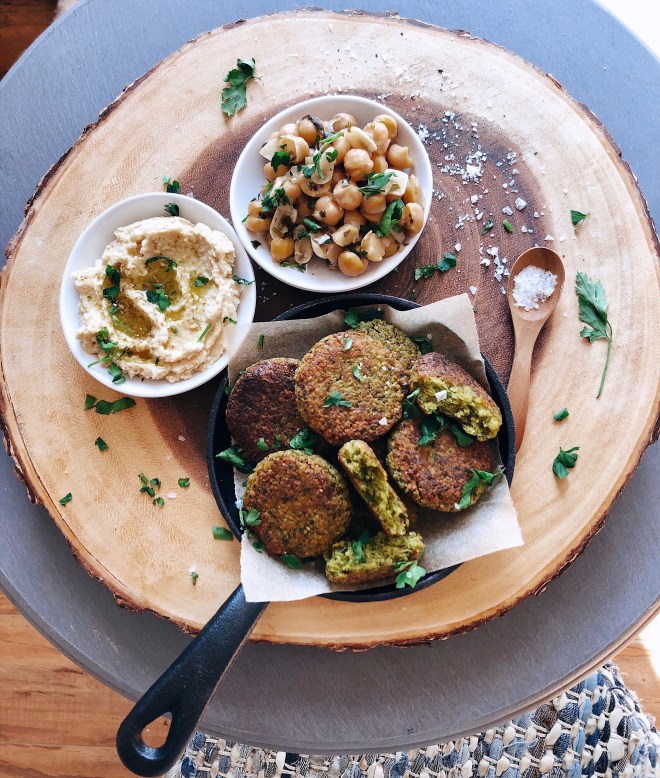
Dried Garbanzo Beans: Three Ways – Cooked Beans, Falafel or Hummus

Well it goes without saying these days have been an adjustment for most of us and we’re all figuring out the best ways to cope with it. As difficult as it can be emotionally and financially, my hope is that most of you are quarantined at home doing the best you can while we wait and see how the days continue to unfold.

I have been in self-isolation for over two weeks now, only venturing out when necessary. The rest of the time, I’ve been home…working some, reading some, and cooking a whole lot more.

Cooking is my coping method. Not only does it keep me busy (sometimes for hours) but it brings me joy, makes me feel useful, and best of all, leaves me with a fridge full of good food to eat for days.

With all of the panic buying that’s been taking place, especially for pantry items/non-perishables, I’m sure it’s left a lot of you with more cans and bags of dried beans than you know what to do with.

But fear not!  I already keep a surplus of dried beans handy and I love to make a big batch for the week to use in different ways.

Here is a quick video I made that uses one 16oz bag of dried garbanzo beans three different ways: falafel, hummus and cooked beans.  See below for individual recipes and notes.

To begin any of the three recipes, start by pouring the bag of dried garbanzo beans into a large bowl and covering with water to soak overnight. Once soaked, rinse them well with cool water.

Falafel

Ingredients:
-⅓ of soaked garbanzo beans (uncooked)
-1 bunch of parsley (remove stems)
-¼-½ cup of any other greens you might have (cilantro, kale, spinach, beet greens, radish greens, etc. this is optional)
-1 medium lemon
-2-4 cloves garlic (depending on your preference)
-half an onion (any variety works)
-salt to taste
-½ Tbsp cumin
-¼ tsp cardamom (optional)
-½ tsp turmeric (optional)
-¼-½ cup flour
-¼ cup cooking oil (grapeseed, avocado, coconut, etc.)
 
 
Method:
 
-Add all ingredients except soaked beans, flour and oil to a food processor and pulse until well combined, scraping the sides down as you go
-Add soaked beans and pulse until combined, continuing to scrape the sides down
-Taste for seasoning and add salt as needed
-Start adding flour a little at a time (you may not need the full amount) and pulse to combine
-Once you have a smooth paste, transfer to a bowl, cover and refrigerate for at least 30 min or up to overnight
-Remove cooled dough from refrigerator and form small discs
-To cook, heat a cast iron or non-stick skillet on medium high with ¼ cup cooking oil (make sure oil is hot before adding the falafel)
-Place falafel discs in skillet (do not crowd the pan) and cook until browned, about 5-8 min per side (you may have to adjust the heat if they’re browning too quickly or not fast enough)
-Place cooked falafel on a dish until all the dough is cooked
-Serve warm over pita bread, with hummus or tahini, with salads or bowls, the options are endless!


Notes: Falafel is typically made with just parsley but I love to add different greens for extra nutrition and just to use up extra greens I might have. I feel that it doesn’t affect the flavor but try it out as you see fit. There are countless recipes using canned garbanzo beans but I have not had much success with any of them. I have found the best method is to use dried beans that have been soaked overnight for the right texture.


Hummus

Ingredients:
-⅓ of soaked garbanzo beans (cooked in water with kombu for about an hour, until tender)
-1 lemon
-2-4 garlic cloves
-3 Tbsp-⅓ cup tahini (optional but delicious)
-about ¼ cup extra virgin olive oil
 
 
Method:
 
-Add all ingredients except olive oil to a food processor and pulse until well combined
-Continue to pulse and add olive oil to the mixture, scraping the sides down as you go
-Continue mixing until very smooth, at least 3-4 minutes
-Transfer to a bowl/container and enjoy!


Notes: I cook the beans with kombu, a seaweed to aid in digestion, it’s totally optional but I have found it beneficial. It does not add any taste or texture to the beans. You can remove the garbanzo bean skins for extra smooth hummus (very time consuming but worth it if you want the smoothest texture.) I prefer to make the hummus when the garbanzo beans are still warm but you can pre-cook them and keep them in the fridge until you’re ready to make it.  If using canned beans, follow the same process but drain and rinse the beans first (they do not need to be cooked ahead of time).


Cooked Beans

Ingredients:
-⅓ of the soaked garbanzo beans (cooked in water with kombu for about an hour, until tender)
-1 shallot (or onion), minced
-4 cloves garlic, thinly sliced
-salt and pepper to taste
-½ tsp dried oregano
-¼ cup parsley or other herbs you have (cilantro, thyme, etc.), chopped
-3 Tbsp extra virgin olive oil
 
 
Method:
 
-Heat oil in a medium pot and add shallot, garlic, salt, pepper and dried oregano, cook until fragrant about 2-3 minutes
-Add juice of lemon and parsley and saute for another 2-3 minutes
-Add pre-cooked beans and vegetable broth
-Bring to a boil and simmer until most of the liquid is absorbed, about 15 min
-Serve warm, over rice or any other grain, in mixed bowls, with salad, etc.
-Keep leftovers refrigerated. You can add to soups or even puree into hummus as well.


Notes: I cook the beans with kombu, a seaweed to aid in digestion, it’s totally optional but I have found it beneficial. It does not add any taste or texture to the beans. You can use canned beans as well just make sure to drain and rinse them well beforehand. This base works well for any type of bean. I love the delicate flavor of the shallots but you can use any variety of onion you might have on hand. You can also add some red pepper flakes if you like it spicy.

Issue #3
Q&Co. 

Portrait of a Chef #1

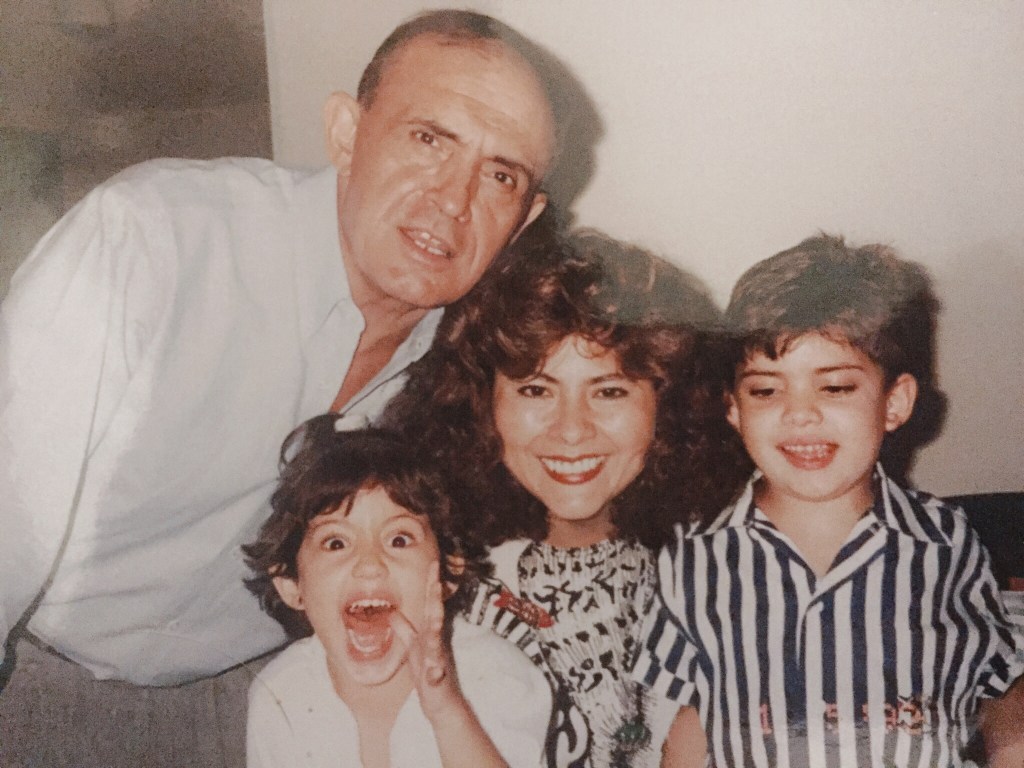
Typical Family Photo – 1992
One day, as per usual, I was scrolling through Instagram and stopped at this post by @briannamadia (by far my favorite person on IG.)  I’ve always loved her writing but this particular caption struck a chord.  In fact, one line stood out from the rest. 
“Not only do we grow up and in to who we are…we grow up and in to who we’ve always been.”
When I think back to being a little girl, I was fearless and uninhibited. I loved to be the life of the party and refused to conform to social norms. I grew up as the only girl in my family and so I received a lot of attention, which was fine by me.
Countless family photos show everyone smiling for the camera with me jumping into the shot making funny faces, throwing my hands up and being silly.  At four years old, when my brother and cousin were playing video games, typically shirtless, in the living room, I’d go and join them until my mom came in and reminded me, as she’d done a million times that I had to keep my shirt on because I was a lady.
I’d stand up to boys on the playground who wanted to steal my toys and share my young opinions with little thought as to what people might think about them.
Of course, as is often the case with kids, everything changed around adolescence.  I became a shadow of who I was, really only showing my true self to those closest to me, which was mostly family. I’d grown shy and deeply self-conscious, scared to speak to people I didn’t know, scared to say what I really thought for fear of rejection. I conformed to those around me so I wouldn’t be labeled different or weird.  Never once stopping to remember the little girl who was so unabashedly herself.
I spent a ridiculous amount of my young adult life questioning myself, living in a state of perpetual self-consciousness and eventually placing my self-worth in the hands of whoever I was in a relationship with at the time. In short, I had forgotten who I was.
Furthermore, I always had a vague picture of the woman I wanted to be, but it felt unattainable. It felt like I could never change, like I’d be stuck in a spiral of insecurity for the rest of my life.


Big Sur Adventures 2016
Fortunately that turned out not to be the case.  I didn’t realize it then, but it had less to do with becoming something I actually wasn’t and more to do with letting go of the limiting beliefs and doubts I had placed on myself.
Thankfully, at 32 years old, I am happy with who I am.  Though of course, that’s not to say this is it, since I continue to reflect on who I am, who I used to be and where I’m going from here. Change isn’t always something happy or easy to go through, but I would always rather evolve than remain stagnant. I am no longer in that shell I lived in for so long, hiding behind a mask of what I thought I should be. 
What’s more is that I hadn’t really considered my experience as a shared experience at all until I read that line.
“We grow up and in to who we’ve always been.”
It made me think of that little girl in the family photos, and I couldn’t help but smile.  I’ve done a lot of growing, especially over the last decade (that’s a longer story for a later time) but those words made me realize something extremely important. 
I am becoming who I always was.

Issue #3
Q&Co. 

Petrified Forest National Park

I left California a few days before the lockdown. I reached Joseph City, AZ by nightfall and parked at a Love’s Truck Station on I-40 where an industrial plant loomed about a half-mile up the road with its lights glowing and smoke rising high in the dark of night.

By this time, I was already considering how best to avoid getting sick, since I still had a long drive ahead of me from Arizona to Fort Lauderdale. I’d never been much of a germaphobe, but now here I was wondering how many people I’d have to dodge suddenly in a place that likely saw travelers and truck drivers come and go every day from all corners of the country.

I’d never paid much speculation to these things before, and now I felt a sting of disappointment at how much current circumstances required me having to think twice about every place I might stop, and how many people I might encounter along the way, and whether I should wash my hands again after briefly touching that door handle which might have been grabbed by who knows how many others.

Yea, it sucked.

In Los Angeles, the biggest talking point concerning the virus was the sudden disappearance of toilet paper in all the grocery stores around town. When I left, businesses still hadn’t shut down but the reality was beginning to sink in, at least for me. Maybe it had something to do with the police helicopter that had been flying over my neighborhood everyday for the past week.

California Desert at Sundown, on State Road 95 outside the Chemehuevi Mountains.

The next morning I grabbed coffee at the Love’s station. It was delicious. I liked it so much I even bought a souvenir thermos. Of all the truck stops across America, Love’s has come to be my favorite. Maybe it’s the name. Maybe it’s the logo. Or maybe I just bought the thermos as a way to settle down and lighten up. Sure enough, during each of the four nights I was on the road, I’d stay at a Love’s Truck Station.  It provided a reassuring familiarity I’d long come to appreciate over the years on the road; and now as things seemed to be getting more serious everywhere, I appreciated that familiarity even more in everything from the country music and tacky t-shirts to the coffee machines and souvenir shot glasses.

To my added satisfaction, as I set out that next morning I saw another familiar face, a National Park that I’d been meaning to visit for a few years now and that I’d bypassed every time I drove down I-40, because I hadn’t had the time or it was too late at night, or some reason or another. It was Petrified Forest National Park.

Now that it was early in the morning and I wasn’t in any particular rush to get anywhere, and probably because I needed the distraction, I decided that now was as a good a time as any to finally see what it was all about.

A quiet morning outside the park entrance; Petrified Forest National Park, AZ

National Parks have always served as an escape for Americans looking to reset and decompress, an escape from the mundane, or from the stress and congestion of city life.  Yet in the coming weeks, they’d receive a new influx of visitors looking to escape the coronavirus.  So many, in fact, that the parks themselves would become congested. 

As I read now of park officials at Grand Canyon currently submitting requests to close down as they field up to 600 visitors in a single day, visitors with whom they undoubtedly come into close contact, I think back to just two weeks ago when I arrived at Petrified Forest. 

I support that request by the way, though I’ll admit, I’m happy I got to visit beforehand when everything seemed totally normal, to the point that you’d never know anything was going on in the rest of the world. 

‘The Tepees’; Petrified Forest National Park, AZ

I parked at the visitor center and watched a quick film about the park and it’s indigenous history.  It felt good to do something normal like that.  To go in and simply look at souvenirs, or get my park stamps and grab a map like I’d typically do.  The rangers were in good spirits and so were the visitors; though again, just like at the Love’s Station, I was suddenly aware of how close I stood next to everybody and felt the same sting of disappointment at the fact.

Then I left the station and set out on the road and into the park, driving alongside the cliffs overlooking the Painted Desert, an endless vista of pink and red rock leading out to the horizon.  The weather was great.  The sky was still a bit overcast, but the sunlight peeking through the clouds felt wonderful on my face.  I could have easily stayed out there all day.    

Along the way I stopped at the Painted Desert Inn and thought about all the people of decades past who’d stayed there and stood out on that same balcony to take in the view of the Arizona badlands. 

The landscape did remind me of the more famous Dakota Badlands some 1,000 miles to the northeast, which I’d visited nearly two years before.  Still while the shades of the green, grey and brown were the dominant colors of that region, here everything was red and pink, and so I might’ve been more inclined to think of Mars, some vast frozen tundra out in space, were it not for that glorious morning breeze and life-giving sunlight. 

Painted Desert; Petrified Forest National Park, AZ

I closed my eyes like I’d done a million times over the last few years in places like Yellowstone and the Everglades, in New Mexico and the Swiss Alps, along the river Danube or the Mississippi, and on the Brooklyn Bridge in New York City.  I closed my eyes and stood beneath the sun, allowing my mind to quiet with the surrounding landscape. 

As difficult as things are getting lately, I’m grateful that I still have the ability to do this, where I can at least step outside my door and breathe in the air provided to us everyday. 

With enough patience, I feel like I can get back to anyone of those places whenever I need.  I thought a lot about this, that day at Petrified Forest, and considered the likelihood that I wouldn’t be able to visit again for a while in the days and weeks to come.  I opened my eyes and looked out over the Painted Desert.  Indeed there was nothing petrified about it.  It was in fact teeming with life.

I’d get back there soon.  In the meantime, it would still be here.  Living and breathing under the same sun, beneath the same stars and moon.  And when I consider that, even today, it doesn’t feel too far at all.  Just like every other place I know and love.

Issue #3
Q&Co.