Let’s get to work

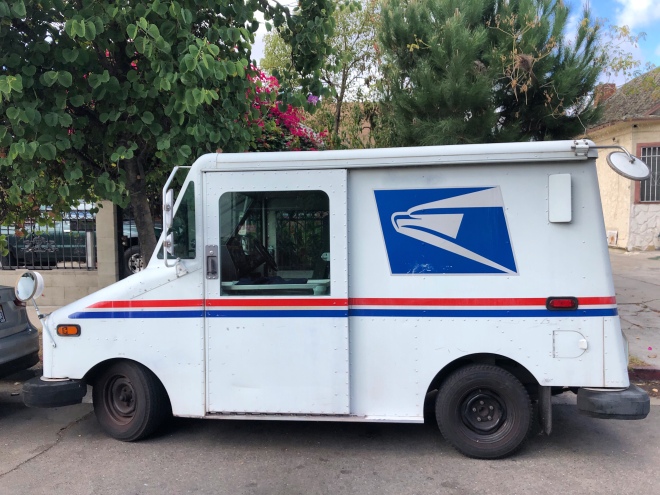
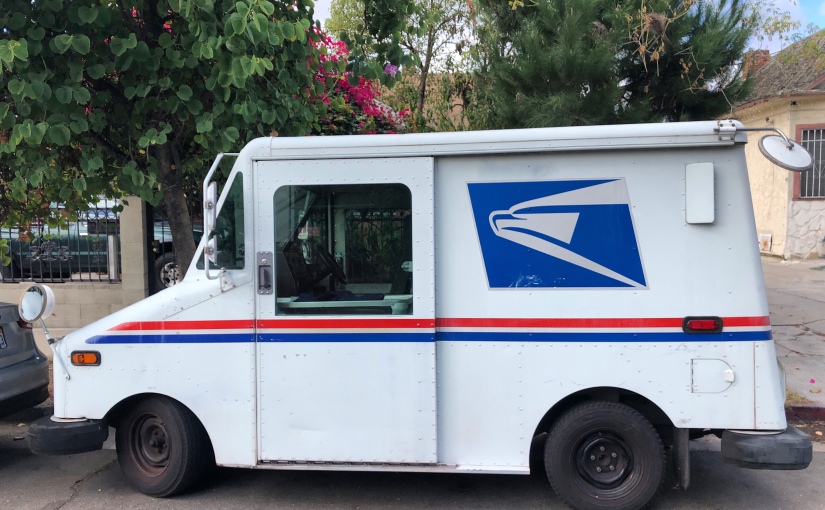
Saturday, November 7 it rained in LA in the early hours of the morning.  I stepped out later as the sky cleared and the sun was breaking through. This mail van had parked across the street as it does just about everyday.

But that day I felt like taking its picture.  To me it’s a symbol that represents the heroes that go unnoticed, whose names we won’t know, whose jobs are usually tedious and not in the least bit glamorous.  A public institution seldom celebrated, much less romanticized.  But it does work, and like anything worthwhile, it gets better the more we prioritize and invest in it.

More broadly then, it represents those who volunteer to work the polls and register voters, who carefully and laboriously counted every vote this year under extraordinary pressure. 

It represents those who stood in line for hours to cast their ballot and boldly defy the pervasive and relentless notion that their voice didn’t matter.

It does matter.  And we proved it this year.

USPS - Mail Delivery Van - Postal Service- Quinby & Co.
USPS Mail Delivery Van. That morning I felt like taking its picture.

No, perhaps the work is not all that glamorous or glorified.  But that’s not why we do it.  

We do it because it’s necessary, because it amounts to something bigger than any one person.  We do it because it makes our community stronger and more inclusive of everyone no matter what they look like, how/if they pray, who they love or who they are.        

In America, we’ve long valued individualism typically expressed through personal ambition and prosperity; and while it seems a natural impulse, I’ve come to appreciate how and why service to oneself and to our community must go hand-in-hand.  It’s necessary to keep a democracy real.     

I am thankful for our public institutions which honor and embody that.  I am thankful for our schools, our roads, our libraries, our public transportation, our national parks and public lands, our postal service and (hopefully soon, with more work) our healthcare.  

And I am thankful for those who’ve worked hard to keep these institutions strong.  Institutions of the people, for the people, and by the people that will–like democracy itself–only grow the more we invest and participate in it. 

It’s most definitely worth voting for.  I believe it’s worth fighting for and living for. 

America, I see you.  Let’s get to work. 


Why We Are Voting Blue in 2020

When we started out in February of this year, we didn’t imagine we’d be making too many direct political or social statements.  We did hope to shed light on the deeper ideas and underlying philosophies that typically steer American politics, such as the size and scope of government or the importance of voter participation, or constructive ways to have a discussion about politics.

The intention was to try and distill the current political landscape from the corrosive, long-established binary model of “Republican and Democrat” or “Red and Blue” into a set of specific issues, complex at times but no less manageable, all of which are more universally relevant than we might realize—whether it’s climate change, racial justice or immigration.

We wanted to make sure the writing never felt like a lecture or came across as preachy in any way.  This was due not to any lack of enthusiasm on our part, but rather what we felt was an understanding of more effective communication, of understanding that nobody likes a lecture unless maybe they already agree with it.

However, this year more than ever before, it seems the virtues of fairness, decency, critical thinking, compassion and listening are on the line.  The deeper underlying principles that govern how we communicate with one another, far deeper than those we hoped to talk about, are themselves at stake.  

This is an election on what we normalize in our collective character and consciousness for generations.     

In the Presidential Election we have one candidate who has demonstrated a fairly consistent philosophy throughout his career while the other demonstrates no real philosophy outside his own brand and the hyper-inflated paranoia he thinks will elevate him politically, beginning almost ten years ago with his crusade to have President Obama prove he is a citizen.

We have one who trusts science and empirical data; while the other says “I don’t think science knows,” in response to what a broad, worldwide coalition of scientific research concludes as a climate crisis caused and further aggravated by human activity.

The reason that listening, critical thinking and empiricism, open discussion and compassion are all at stake is because our current president has proved to be their walking antithesis.  Equally, and quite successfully, he has labeled anyone calling out his vulgarity as too politically correct or sensitive, which has only encouraged a growing culture of not listening, unfounded conspiracies, bigotry, sexism and delusion.  

Examples of his oafish and repulsive behavior include but are certainly not limited to a gross imitation of a reporter with a disability, and saying that John McCain “is a war hero because he was captured. I like people who weren’t captured.”  

The will to survive and maintain one’s honor in the face of overwhelming despair and torture is indeed heroic; and anyone who has heard the story of John McCain’s five and a half years in a North Vietnamese prisoner of war camp must recognize Trump’s statement as not politically incorrect, but simply indecent, heartless and foolish.  Donald Trump never served in the armed forces.  He’s never tasted real danger in his life.  

Other examples include drawing an equal degree of blame between white supremacists–some of whom Trump declared to be “very fine people”–and those who stood up to them in Charlottesville, Virginia; and then most recently, the mocking of those taking COVID-19 seriously as he continues to hold open rallies with no social distancing or requirements for masks while the pandemic has now claimed over 200,000 American lives.

To that point we’ve provided a tweet posted by Donald Trump 23 hours ago as of this writing, drawing a comparison between one of these rallies, and a speaking event for Joe Biden in which people are exercising responsible safety measures and social distancing.  Yes indeed, there is a stark difference.       

Joe Biden has demonstrated a personal and political philosophy founded mainly on compassion, critical thinking and facts.  Donald Trump evidently isn’t deep enough to think about anything other than himself.

Beyond the scope of the Presidency, we are witnessing the mutation of a political party into a warped and twisted cult of personality that seems to honor and endorse whatever Donald Trump tells them.   

In 2013 the Republican-led Supreme Court voted to cut a critical component of the Voting Rights Act which required districts with a history of voter suppression to get federal approval before making any changes to their election laws.  This ultimately led to the closure of more than 1,600 polling places throughout the South, typically in Black communities and communities of color.  House Democrats passed a resolution to restore the Voting Rights Act, but it has yet to be passed in the Senate.  It still sits on the desk of Mitch McConnell, the Republican Majority Leader, as it has for over 200 days.    

In Texas meanwhile, 750 polling places closed following the Court ruling.  Most of these closures took place between the 2014 and 2018 mid-term elections. 

Just weeks ago, the state’s Republican governor issued an order to limit the number of places voters could hand-deliver their mail-in ballots to a single location per county—clearly problematic for the populous Harris and Travis Counties for example, which had previously designated a dozen and four drop-off locations respectively.  

Of course, the Republicans’ latest egregious attempt at holding onto power regardless of popular will reveals itself in the confirmation of Amy Coney Barrett for Associate Justice of the Supreme Court.  She was confirmed three days ago by the Republican-led U.S. Senate—eight days before our election.  In 2016, a whole 293 days before the election, the Senate, still led by Republicans, refused to hold a hearing for President Obama’s nominee, Merrick Garland.  Their reasoning for delaying the vote four years ago was that it was too close to an election, and that the American people should have a say on the selection of the next Justice.  

Of course, with a dim fraction of that time remaining this year, that reasoning somehow no longer applies in the confirmation of their own nominee.  The double-standard and hypocrisy is loud and clear. 

The Republican Party itself has been morally declining for years, as they have proven to care strikingly little about actual democracy and equal representation than they do about holding onto their power.  They know the majority of eligible voters don’t stand with them.  The people don’t stand with them.  The country doesn’t stand with them.  And consider this additional fact.  In the last 30 years, a Republican candidate for President has won the popular vote just one time.  The Democratic candidate has won six times. 

Yet the Supreme Court now has a 6-3 conservative majority.  Something’s not adding up.  Given one party’s long enough history of suppressing the vote—alleging voter fraud whenever they can, in a country where less than half of eligible voters even vote at all—it should be pretty clear why that is. 

We can debate all day the size and scope of government in our lives, the strengths and pitfalls of capitalism, and a host of other ideas that invite different points of view.  But the modern-day Republican Party and their chosen leader and champion have long outstayed their welcome.  It’s time to vote them out.  

We are voting for Joe Biden and Kamala Harris, along with Democrats up and down the ballot; though not just because they are, quite simply, everything the Republicans are not.  We cannot vouch for every candidate individually, but we can say that as a whole, over the past twenty years, they have done far more to expand voting rights and access to affordable health care, they’ve worked far more to cultivate a cleaner and more sustainable environment, and they’ve fought far more for equal justice. 

In this election, more so than ever, there is really no comparison.  

We are voting for Joe Biden and Kamala Harris.  We are voting Blue up and down the ballot.  We encourage you to do the same.  

Please vote.  And if you can, vote early and in-person.  

Thank You.   
In-Brief: On Parks and Wildness

Save Our Home, Save Ourselves

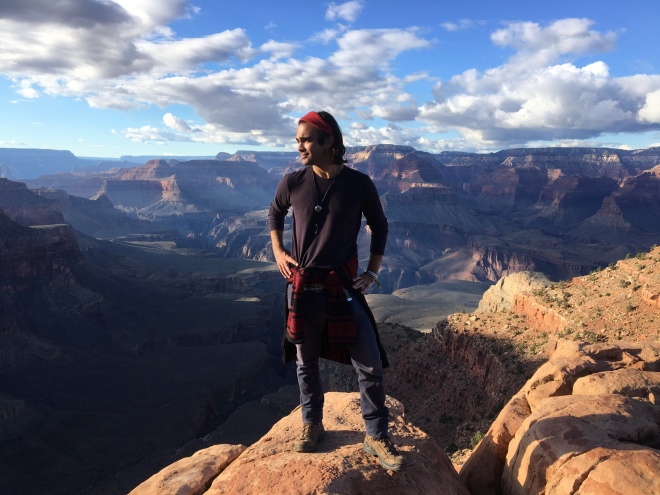
I recently applied to a job that asked me to select the best pic of myself in the outdoors. It sounds like it could be an exciting one, a job where I’d be spending time in some of my favorite places, or one place depending on how you look at it. That is, the National Parks or in the broader sense, in nature.

To that point, I’ve come to see them less as individual places and it more as one larger whole.  Our planet.  I like that approach more.    

It’s hard to say which picture could ever be the best, but this is the one I felt like posting–taken almost exactly four years ago.

Ren Michael - South Kaibob Trail - Grand Canyon - Grand Canyon National Park - Arizona - National Park - Quinby & Co.
Ren Michael on the South Kaibob Trail, Grand Canyon National Park, AZ

Much has happened since then both in my life and throughout the world, and I’ve been fortunate to have gone on many adventures in the time in between. Hopefully I’m a strong sum of those experiences, as each was its own unique reminder of my connection to both land and people.

I’m not unique in that respect, since I know many who have turned to the outdoors and felt a similar way. Restored, replenished, readjusted to the point that their day-to-day ambitions either suddenly feel silly, or are just given renewed purpose in light of the bigger realization that they are a part of something bigger than themselves and their possessions.

While I can only hope it’s enough to help us recognize the importance of preserving these places—since all of us deserve to experience the land in equal measure—above all, I hope we each begin doing our part in preserving the integrity of our environment, for the health of our planet, our one true home, for our physical health, and ultimately for our sanity.

I look back on recent years and I think about people marching against gun violence, or against corporate greed on Wall Street.  I think about people marching for Black lives and for our government’s full recognition of their humanity. 

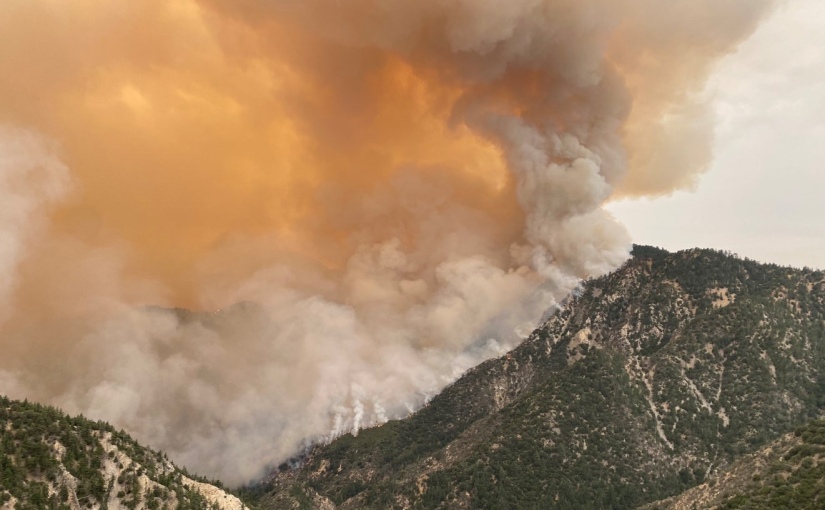
And I think about two weeks ago, when everyday I stepped out and saw a smoke-filled sky blotting out the sun due to devastating regional wildfires.  In the back of my mind, the fire’s reach had far exceeded the limits of the west coast where I make my home.  Indeed, the larger symbolism was hard to miss.      

The issues of violence, racial justice, environmental justice and economic inequality are, I believe, inter-related.  The dangers of climate change for example pose the most immediate threat to Black and Brown communities, a disproportionate number of which fall below the poverty line in the United States and throughout the world–a reality most clearly demonstrated in food and water shortages not just in third-world countries, but here at home.  

Tackling the threat of climate change will not automatically close the gap on income inequality or accomplish comprehensive racial justice.  Still you cannot adequately address problems in your house when your house is, quite literally, on fire; and truly, the fight for a healthy planet has the power to bring people of different backgrounds and beliefs together, likely more so than any movement we’ve ever witnessed.  More to the point, it’s the understanding of our interconnectedness that will ultimately save us in virtually every domestic and global conflict we experience; and nowhere is that realization more critical than in the necessary global effort to mitigate climate change by cultivating a cleaner and more sustainable world for all people.  

The act of getting outdoors, spending time in our public lands and in the broader wilderness of the world has the unique power to reinforce the fundamental reality of our interdependence and dependence on the land.  It’s just one of many reasons why it’s so important they stay preserved and protected.    

I often reflect on whether it will just be an ongoing battle for every generation between people committed to preserving our wilderness for the public benefit, and the people who seek to exploit the land for their own profit. 

I hope that it won’t.  Maybe the dual threats of climate change and a global pandemic will convince people of their stake in each other’s health and the health of our planet, and the influence will carry over through generations to come.      

I only know that the need for such a realization has never been so urgent.      

As for our wilderness, and it’s unmatched beauty and healing power, for now there’s little more I can say, other than to simply go, as soon as you can, and experience it for yourself.

Let’s please take care of our home.  I am committed to doing my part and I hope you will join me.  The Sierra Club is one of our nation’s most enduring and influential forces for environmental action and awareness.  I’ve been a member for a couple years now and I urge you to consider joining and lending your support as well. 

Let’s get to work.   


*Take Action –> www.sierraclub.org

Friends of the Earth Action https://foeaction.org/

Natural Resources Defense Council https://www.nrdc.org/

National Parks Foundation https://www.nationalparks.org/

Talking About Political Correctness

The growing consensus seems to be that everybody everywhere takes everything personal all the time, which may yet be true.

The complaint seems warranted with respect to professional comedy where part of what makes a joke funny at all is its irreverence, its breach of political correctness. If a comedian were constantly wanting to avoid offending people, that comedian would likely lose inspiration and give up the whole thing. 

Comedy thrives on irreverence. Even so, the best comedians still grasp the basic concept of knowing how to read a room.

When people look at their life and really think about the number of times they’ve been slapped on the wrist by a friend, family member or acquaintance for using the wrong word or making an insensitive remark, is that number actually few and far between?

Is political correctness simply a fact of life, no different from any other form of etiquette that will change depending on where you are in the world? Might the only difference now be that it has a name, and that it’s been stigmatized in the one sphere of public life where it’s probably essential–politics.   

I wonder whether people who complain about having their head bitten off for breaching that etiquette, who yearn for some comprehensive, universally agreed upon rubric for what’s ok and what’s not, and who then further expect it to never change, ever again—at least while they’re alive—are simply operating in some other reality; as if anything like that ever existed within the long span of human history and the diversity of cultures that make up this planet, let alone the ones that make up this country.   

They’ll mention how it used to be different years ago, how somethings were ok and others were not—as if the ideal history of language and expression is a static one, where things don’t eventually fall out of fashion.  

Social change might be a phenomenon but if we can’t accept it, then we might want to find ourselves another planet.

The complaint ignores the fundamental truth that language changes because people change.  It ignores the fact that larger, free-thinking societies are quite naturally heterogenous.  The bigger they are, the more diverse they will likely become, with each community and sub-community developing their own customs and standards of decorum. Political correctness at the very least seems to represent that basic truth in the matter of how we converse with one another, when each of us comes from a different background and our own sphere of personal experience.  

I’ve noticed that people who travel a lot typically have no problem understanding this, because they’ve spent a good amount of time in communities other than their own. They learned to adapt, and often a part of them even enjoys navigating the complexities of different cultures.

They don’t get upset over the fact that they have to learn a new language, they embrace it as an opportunity. If something changes in the country or community they visit and they have to adapt yet again, they don’t dismiss the people as petty and refuse to budge any further.

They are often driven by an appetite for learning new things, and a wonder before all the intricacies of the world and its many points of view.

They don’t get hung up on the possibility of making a mistake here and there, because they’ve already accepted the high probability that they will sooner or later.

However, that leads to another point of discussion.

Could those who are hip to the changing tides of fashion be more polite about it? Is being woke, for example, nothing more than a matter of bragging rights, one that ultimately involves shaming all those who are out of the loop?

I used to complain about political correctness because I’d automatically bought into the notion that these types of people were everywhere and running absolutely wild, even though I never met one. I think it had to do with insecurity. My own fear of making a fool of myself led to a defense mechanism against the enemy I had never actually seen. I think the woke phenomenon is probably motivated by the same fear. Fear of not being hip, being out of step with the times. An outsider.

I don’t think there’s anything necessarily wrong with being ignorant. I think the real pity is either burrowing yourself in your ignorance, or over-compensating in the direction of righteousness or enlightenment, all for the sake of never being wrong and being some kind of insider.

In a way, ignorance is the underlying motivation for why I travel. To learn. And while I like knowing that I can adapt easily enough to changing surroundings, doing that involves a flexibility of perspective, an openness to being wrong every once in a while, and an eagerness to listen.

In Focus: What is the Green New Deal?

These days we’re hearing more and more about the Green New Deal and rightfully so.  Given the devastating wildfires along the west coast, which only seem to grow in number and intensity each year in proportion to rising global temperatures, we think that a Green New Deal sounds great right about now. 

But what exactly is it?  What does it entail and is it practical?  We did a little research and were able to iron out some nuts and bolts, say, for your added consideration when casting your vote this year.  So let’s take a look.

The Green New Deal is a congressional resolution, essentially the most comprehensive plan for mitigating climate change and reducing income inequality put to paper by our government so far. 

You can read the official document here.

It was drafted last year by Rep. Alexandria Ocasio-Cortez of New York and Sen. Edward J. Markey of Massachusetts, both Democrats, and it takes its name from the New Deal of the 1930s, a series of programs and regulations enacted by President Roosevelt as a means to help the United States recover from the Great Depression. 

It emphasizes that climate change and income inequality are inextricably linked, and that the proposals would cultivate a cleaner environment and create new jobs. 

These proposals include a sweeping national mobilization effort that would be implemented over a ten-year period, one that includes sourcing 100 percent of our power demand from renewable energy and zero-emission resources (e.g. wind, water, solar). 

It calls for the overhaul of our transportation system to remove pollution and greenhouse gas emissions from the transportation sector as much as possible–by investing in zero-emission vehicle infrastructure and manufacturing, in affordable and accessible public transit, and in a high-speed rail system.

Additionally, the resolution says it’s the duty of the federal government to provide job training for new workers, particularly those families and communities who currently rely on their jobs in fossil fuels.


The Details

But is it feasible?  Can it actually work?  That’s where things seem to get a little tricky.  

Almost 80 percent of America’s power still comes from fossil fuels, a resource that is relatively cheap and plentiful.  Another problem is that the cost of these new initiatives would indeed be expensive, though supporters argue that it’s a cost that would pay for itself in the long run.    

Additionally, as Republicans are equally quick to point out, the Green New Deal would involve a greater government presence in many facets of public life to adequately implement the standards necessary for curbing our greenhouse gas emissions.  In short, it would go against the common instincts and virtues intimately linked with modern American industry, namely less federal regulation and more privatization.  

Now to that point, one might hope that a global pandemic might shift the collective consciousness enough to translate into policy that actually reflects the popular sentiment that we’re all in this together.  After all, when it comes to climate change, that sentiment has never been so true.

The logistical obstacles most often mentioned are the costs and the ten-year timeline.  While the cost of reaching the goals outlined in the resolution would amount in the trillions, the cost of continued inaction would almost certainly amount to trillions more.

While technological experts agree that ten years might be too short a time to achieve the zero-carbon infrastructure outlined, they do agree that 20-25 years is more viable if we get to work now.  


Our Take

Something is better than nothing.  While the logistical dilemmas might be valid, specifically whether ten years is too short a time, the simple truth is that we need to try.  

Every time we hear about the threat of climate change–a threat, by the way, that is already here–we naturally begin talking about solutions.  And the solution is basically the same every time, involving each of us making individual sacrifices for a greater more common good.  The Green New Deal is essentially that very realization put to paper and hopefully, ultimately national policy.   

If the fundamental ideas of the Green New Deal seem far-fetched, then it says an awful lot more about us then it does about the ideas themselves.  To throw up our hands and say it’s all a fantasy is to say that we’re incapable of working together to promote the general welfare.

Of course any such notion is nonsense, and a person only needs to look at history to understand why. 

It’s very appropriate that the resolution borrows its name from the New Deal of the Depression.  Then as now, Americans were facing a cataclysmic event that had upended public life for several years, not to mention the looming threat of a second world war.  It begs the question of just how catastrophic things need to get here and now before ordinary people across this land recognize a similar sense of investment in one another.

Despite the logistical issues this new new deal, it’s still the most tangible form of action we have yet realized in addressing climate change through legislation. 

If we cannot succeed in every aspect of it, we might succeed with some if not most of it–and some is most certainly better than none. 

It’s a blueprint, at the very least, a guideline we can follow in the years to come for enacting policy that would provide for a more sustainable environment and equitable society.  Of course that’s no small thing, and we personally put more trust in those who see its value versus those who outrightly dismiss it.

Apocalyptic skies in San Francisco, CA. The lights are still on along the Bay Bridge, which are supposed to turn off after sunrise. Photo by Jessica Christian, San Francisco Chronicle

In Focus: The John R. Lewis Voting Rights Act of 2020


John Lewis has received a great deal of praise over the last several weeks following his passing in July. 

Everyone from former presidents and congressional leaders to the innumerable voices in social media have highlighted his legacy fighting for Civil Rights both on the streets as he marched with Martin Luther King and in the halls of Congress where he served as a Georgia Representative for over 30 years.

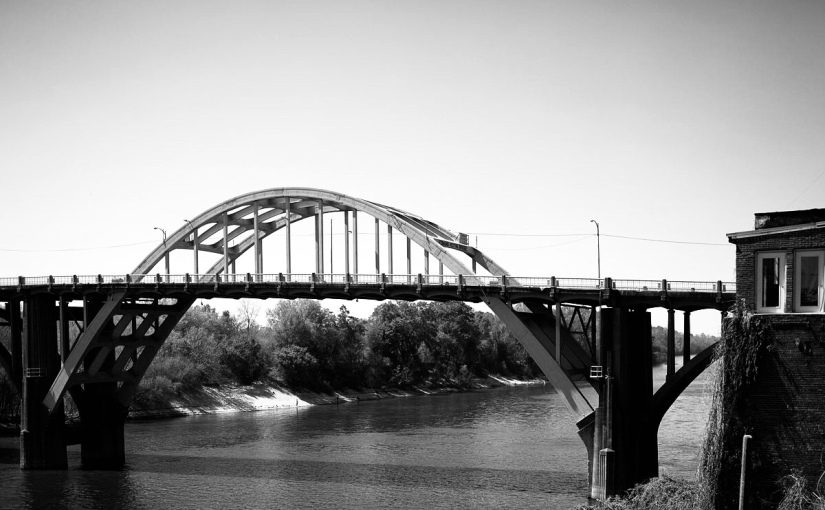
We’ve heard about his near-death encounter with Alabama State Troopers on the Edmund Pettus Bridge while peacefully marching for the equal right to vote, and his multiple arrests in the name of what he called getting into good, necessary trouble.

What few people may realize is how the very thing for which he fought has been jeopardized these last seven years, and how its restoration formed a driving cause to which he dedicated his remaining years as a legislator and citizen.  

In 2013, the Supreme Court removed a key component of the Voting Rights Act of 1965, one that required districts with a history of voter suppression to get federal approval, or preclearance, before making any changes to their election laws.  

The Court ruled that the provision as it stood was based on antiquated data, essentially stating that the barriers which once disenfranchised Black voters in those districts no longer exist. If the Federal Government wanted to reclaim its oversight, the Court ruled, it would have to do so based on contemporary data.

So while the preclearance provision still exists, it’s no longer being applied, since the specific districts once required to get the federal approval are no longer required to do so.  Many of these districts are comprised of southern Black communities. 

“Today the Supreme Court stuck a dagger in the heart of the Voting Rights Act of 1965,” said Lewis at the time of the ruling. “They’re saying, in effect that history cannot repeat itself.  But I say come and walk in my shoes.”

While it’s true that the more overt forms of voter suppression are gone–such as poll taxes and literacy tests–many others still remain such as the restricting of early voting, the arbitrary re-drawing of district maps, strict voter identification laws, and the closing of over 1,600 polling places between 2012 and 2018 in those same districts once required to get federal approval before making any of these changes.  In Texas, 750 polling places closed following the Court ruling.  Most of these closures took place between the 2014 and 2018 mid-term elections.     

In December, the House passed a bill to restore the Voting Rights Act.  Congressman Lewis led the drafting of the bill, which was based on the updated data the Court had ruled necessary.  After the congressman’s passing in July, the bill was renamed in his honor–The John R. Lewis Voting Rights Act of 2020.    

It has yet to be passed in the Senate.  It currently sits on Majority Leader Mitch McConnell’s desk, as it has for well over 200 days. 

Without a Democratic majority in the Senate, and while President Trump remains in office with his power to veto, it is unlikely the bill will be signed into law.  

Note: Election Day has yet to be declared a federal holiday, though it consistently falls on work days in which many Americans don’t have the time to get to their polling place and vote.  Colombus Day, meanwhile, is still a federal holiday.  Let’s all vote this year, yes?


Here are resources to take action.

https://support.naacp.org/a/john-lewis-voting-rights-act-passes-house”>https://support.naacp.org/a/john-lewis-voting-rights-act-passes-house

*The following data was compiled by the Leadership Conference Education Fund, a research arm of the Leadership Conference on Civil and Human Rights: http://civilrightsdocs.info/pdf/reports/Democracy-Diverted.pdf


Fresh Hibiscus Lemonade

After casually posting a video to my IG stories of a batch of Hibiscus Lemonade I made last week, I was so surprised at all the messages I got asking for the recipe. This was the easiest “no recipe” recipe I’ve made in a long time and it was inspired by the Jamaica Agua Frescas I love to order whenever I go to my local taco stand here in LA.

I wasn’t necessarily planning on making this delicious drink but I happened to find the dried hibiscus flower in bulk on my first visit to Tare Grocery and immediately had to have some. I love hibiscus, it’s so tasty and so good for you too.

When I got home I remembered all the lemons in my fridge and got to making some lemonade with my newly purchased flower. I brewed the tea, added raw honey for sweetness, some freshly squeezed lemons and a lonely orange I found hiding out in my fruit drawer. It came out wonderful for just throwing a few things together unplanned.

If you can find some dried hibiscus flower, I highly recommend making this in bulk and keeping a pitcher in the fridge for a refreshing drink all summer long. I’ve already made a second batch. Enjoy friends! Recipe Below

Fresh - Hibiscus - Lemonade - Hibiscus Lemonade - Andrea Pavlov - Quinby & Co.
Fresh Hibiscus Lemonade by Andrea Pavlov

Recipe:

-2 Tbsp dried hibiscus flower
-4 cups water
-¼ cup raw honey (more or less depending how sweet you want it)
-4-5 lemons
-1-2 oranges

-Bring water to a boil and steep the hibiscus for 15-20 minutes
-Meanwhile, squeeze your lemons and oranges (it should yield 1½ – 2 cups juice)
-Remove hibiscus and mix in your honey while the tea is hot so it melts
-Add the lemon/orange juice and mix
-Pour in a pitcher and let cool to room temperature before storing in your fridge
-Can be enjoyed hot or cold!

Marinara Sauce and the Beginner’s Mind

It was a year ago today, around my birthday, when I was thinking a lot about Italy and the food I’ve loved since I was a boy.

I never thought of myself as much of a cook, but over the past year I’ve come to see that the fundamentals of cooking aren’t half as complicated as I thought. 

And while I can’t pinpoint exactly how or why it began with marinara sauce, I think it had something to do with travel. 

I was 18 years old when I first visited Italy and the experience changed my life.  For one thing, it was one of the first countries where I spent any good amount of time outside of the States.  Not only did it broaden my perspective, but it did so in a way that inspired a deeply-rooted trust in the basic goodness of people, a trust that continues to this day. 

Never in my life had I met people who were so consistently happy, helpful and welcoming; and the realization was enough to make me weep especially when complimented with a cuisine so unbelievably good that I was convinced I could feel the love of a people put into it with every bite. 

And then of course, there was the wine.  I’d never really sipped or much less enjoyed wine before, but that first night in Rome marked the beginning of a love affair which, as my best friends will certainly tell you, also lasts to this day.  Chianti remains my favorite wine.  Forever and always. 

Simply put, Italy is one of the most friendly, romantic, sexy, joyous and culturally rich countries I have ever visited in my life.  It was an incredible way to begin what I further hope is a long life of travel. 

So I guess I can tell you exactly why I began my cooking trip with marinara sauce–because every time I make it, I reflect on these experiences.  I think about the old ruins and cobblestone streets of Rome, the ornate fountains, the candlelit restaurants that feel like they might stay open all night.  I think about the hills and cypress trees of Tuscany, and the Arno River in Florence glowing in the moonlight.  I think about the history.  The ghosts of the Coliseum.  I think about the art.  The art!  This is the land of Michelangelo and Leonardo Da Vinci.  The Renaissance.  The opera!  This is La Dolce Vita and the surrealist dreams of Fellini and the great masters of Italian cinema.  

It’s a place where time doesn’t exist except in all the right ways, and for all the right reasons, where you’ll see flashes of modernity amid the backdrop of ancient ruins.  For me, life is a flashing moment and one great big beautiful trip that ought to be celebrated and revered.  Italy is a place that encapsulates that realization, one that I hope is a realization for the rest of the world that encourages us to not take life for granted, but to cherish it and truly cherish one another.

Finally there’s one other reason why I appreciate making the sauce.  As it’s a reminder of that first experience in Italy, perhaps by extension, it also reminds me of the excitement in beginning something new, something that’s about to unfold in a way I can’t even begin to imagine.  

It’s the thrill of being a beginner, when everything is unknown and mysterious and you’re unburdened by any heavy expectation because, in the beginning, you’re too humble and open-minded to indulge it.  I try to maintain that mindset in everything that I do.  Though I’ve learned and experienced a lot in the time in between, I still like to consider myself an amateur.  I wouldn’t have it any other way.

Ren Michael - Marinara - Quinby & Co.
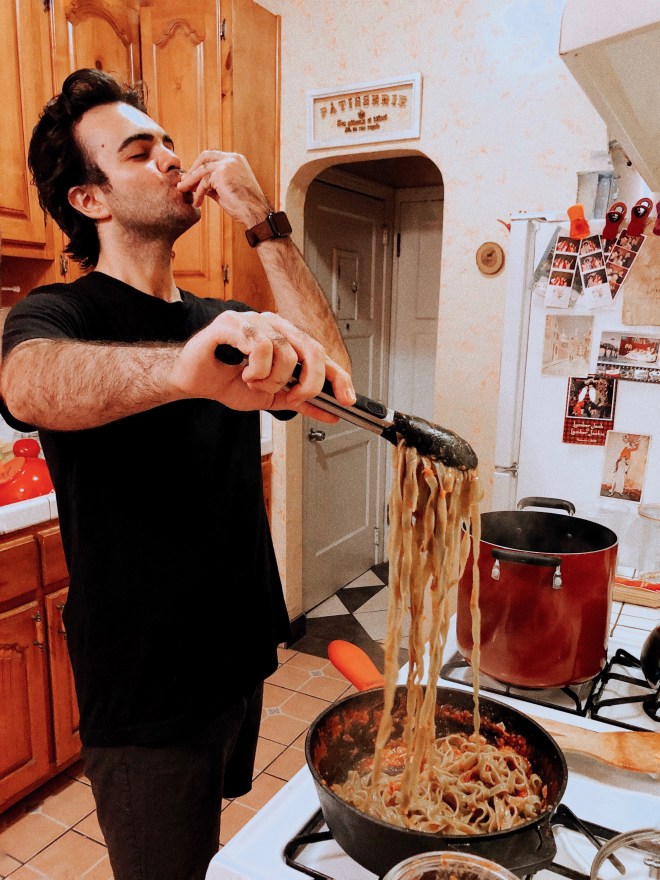
Molto Bene! Me in my kitchen, the night I first made the sauce.

Now, let’s get to the dish.  Like many people, Italian food is my favorite cuisine, and though I’m inclined to say that it’s more the intangibles that I appreciate the most–the warmth, the attitude, the lack of pretentiousness, the familial, convivial nature of the restaurants and the country, the red wine and all those wonderful things I mentioned earlier–if there is one constant that makes me enjoy Italian food as much as I do, I would have to say it all comes down to the sauce.  

Since I was new to cooking, I figured marinara was a simple enough dish to start, since it incorporated so many basic principles of cooking: using fresh ingredients, prepping the ingredients, using oils and garlic effectively, knowing how and when to add salt for taste, and then, my favorite part, the process of letting something cook slowly while you periodically check in to stir, maybe add more salt or get a better idea of how much time you have left.  Of course, you’ll likely add your own flourishes and personal touch with time, as I typically do myself, but here are the fundamentals.

Recipe:

1 can of whole tomatoes (preferably San Marzano)

1/4 cup of extra virgin olive oil

7-10 cloves of garlic

A little basil

Salt

And that’s all you need my friends.

Directions:

Prep your garlic by slicing thin.  The thinner the better.

Crush the tomatoes by hand in a big bowl.

Add the oil to the pan and heat over medium, add the garlic and then let it sizzle, 1-2 minutes so it doesn’t burn.  When that happens, go ahead and add the crushed tomatoes.  I like to add a cup of water, which I’ve poured into the empty can of tomatoes to get any remaining bit of sauce.  

From here, just let it look and stir every twenty or thirty minutes.  Add salt to taste.  When it starts smelling real good and the water has absorbed, you’ll have your sauce, finish off with thinly sliced basil.  Buon appetito!  


https://open.spotify.com/playlist/5FMr9L7gV2e051jFmqohf6?si=JBaDJ1VTQR6k91lOQ-OvNQ


Suggested music:

As you can see, we’ve provided our own curated Spotify playlist above.  If you’re looking for upbeat, Louis Prima is the way to go.  If you’re looking for romantic, try anything by the legendary tenor Luciano Pavarotti.  You might also consider the soundtrack to the Godfather. 

For some reason I enjoy listening to film scores when I cook.  Another great album is the score for Anatomy of a Murder by Duke Ellington.  If you’re looking for smooth, try Quincy Jones’ I Dig Dancers or The Quintessence, or Henry Mancini’s score to the Pink Panther.


Ren Michael - Signature - Quinby & Co.


Quick Tips: Photo Albums

As we continue life in quarantine and many of us spend an increasing amount of time at home, you may or may not have slipped into something of a routine or found yourself doing things to keep you busy or your spirits up.

One thing I’ve found particularly worthwhile is going through photos in my phone.

Now bear with me, because I know it sounds strange. Probably because it is. It’s also a simple way of passing the time which, for me, has proven to be a strong mood booster particularly when things around us seem so uncertain these days.

I take a lot of photos. Probably too many. Maybe I’m a nostalgic person, but I think the habit is due more to the fact that I like to celebrate moments. I take the pictures less as an insurance of not forgetting something, and more as a simple tribute to that singular moment in time.

It’s not that my memory isn’t good, I’m just generally a more visual guy and having the image helps me internalize the moment on another level.

In any case, it leaves me with a fair amount of photos, and while organizing them might seem at first like a tedious job—which it sometimes can be—with the right attitude, it can actually be very gratifying.

If you’ve ever gone through old photos with a family member, maybe old printed copies that were stashed away in a closet somewhere that neither of you had seen in a long time, then maybe you see where I’m going.

I know for me, in those moments, I walk away feeling less nostalgic and more grounded. I walk away with a better understanding of where I come from.

So let’s say I’m go through my photos and delete some, ‘favorite’ others, and as I’m going through maybe I’ll create an album and begin sorting them accordingly. All the while, I’m reflecting on past experiences which–in both subtle and obvious ways–naturally made me who I am.

Put more simply, going through our own history is useful for the same reasons it is going through any kind of history. It helps us better understand and appreciate how we got here. It keeps us grounded. Our feet are more firmly rooted with a greater understanding of self.

And so as we navigate the road ahead, and some of us are pushed to limits we never anticipated, remembrance might prove more valuable, and more necessary than we realize.

Penetrating the Aether: Are We Listening?

Has social media made us better communicators?

No! Ok I’m not exactly sure, but I’m inclined to think not since it’s removed face-to-face confrontation, a core component of meaningful conversation, from our everyday lives. That’s not to say we were generally good communicators anyway, even before ten or twelve years ago.

Still, I do think social media has aggravated many of our common weaknesses, such as vulnerability to ego, an unwillingness to be wrong, and not listening.

The same can be said for texting but I’ll get into that, as well as social media, some other time. What’s more interesting to me, and likely more important for the sake of cultivating a more prosperous society, are those weaknesses I just mentioned. Besides let’s face it, social media isn’t going anywhere. It’s prevalence in our daily lives is unlikely to change anytime soon. Nor should it.

No, what I think ought to change more immediately is our handling of it, so that it’s presence in our lives isn’t quite as relevant, or at least so it’s less damaging.

To do that we’re going to have to get a better handling on how we have conversations with each other, independent of the platform we use to do it.

All anyone needs to do these days is go on YouTube, and look at the arguments people have with one another in the comments section following any political post. If just the thought of doing that made you cringe just now, you’re not alone. I feel the same way. “Who are these people?!”

That’s just it. They’re us.

While YouTube in particular can seem like a cesspool for vitriol and hate, we can’t be so quick to righteously distance ourselves from them, because at the core of those forums, I think, lie the same fundamental problems that dog even the most diplomatic among us. Ego.

That my friends, is one pesky son of a bitch.

Now let’s just imagine, for a moment, that ego didn’t exist in the world. What would it look like?

Are you smiling yet? Keep trying.

Alright that’s enough. Maybe you didn’t smile. Maybe you’re not the smiling type, and that’s ok. We still love you.

The point I’m trying to make is that most of us go into our conversations and arguments as though it’s a contest. But that’s just it. It’s not a contest. That’s an illusion perpetuated over the last thirty years, with the rise of cable news and programs that pit one person against another like two swordsman representing their warring tribes.

The greatest deception men suffer is from their own opinions.
-Leonardo Da Vinci

We don’t owe our allegiance to our ideology. We owe it to the truth. Granted, the truth is something more abstract if not multi-dimensional, but it’s universal. Thus, the aim for each participant in a conversation cannot be winning, which naturally pits one against the other. The aim must be to arrive at a common truth, which requires working together.

When that happens, we no longer care about being wrong. We’re no longer terrified at the prospect of losing an argument, and why should we be? Really, we don’t lose at all. If you find that you’ve come around to embracing another person’s point of view, you didn’t lose, you just discovered something that you’d overlooked before. You’re a wiser person for it.

There’s nothing to be bitter about. You’ve simply worked together with someone else at uncovering a broader truth. That’s something to celebrate, not scorn.

Finally, when we lose the unfounded fear of being wrong, a third thing happens. We are more able to listen. We’ve removed ego, fear, insecurity, bias and judgement from our point of view; and so we can more adequately listen to the person in front of us, with respect and a clear devotion to something bigger than ourselves.

This might sound like an oversimplification, but it’s really just a small change, a slight shift in our thinking that can make a monumental difference in our society–let alone in our personal relationships–the more people follow through with it. If we remove our ego from the equation, and step out of our own way, we no longer have one hand tied behind our back in how we communicate with one another.

This, I’m convinced, is the essential core of a healthy country and a truly self-sustaining democracy.

__

P.S. for those of you who made it this far, thanks for listening! Here’s a token of our appreciation.